






You’re venting to your mom about your partner again. Or maybe you’re the one caught between two family members who won’t speak directly to each other. Perhaps you notice that every argument with your spouse somehow involves bringing up what your sister said. If any of this sounds familiar, you’re likely experiencing triangulation in relationships.

What Is Triangulation in Relationships?
Triangulation happens when two people pull in a third person instead of dealing with their conflict directly. Rather than talking to each other, they talk about each other, through someone else.
Psychiatrist Murray Bowen first identified this pattern in the 1950s while studying family dynamics. He noticed that two-person relationships are unstable under stress. When tension rises, people instinctively recruit a third party to relieve that pressure. A triangle is the smallest stable relationship system. Why? Because tension can shift around three relationships instead of staying stuck between two people.
The problem? Triangulation in relationships only reduces anxiety for the two original people. It dumps that stress onto the third person. And nothing actually gets resolved.
How Does Triangulation Show Up in Families?
If you grew up being your parent’s confidant about their marriage, you’ve experienced triangulation firsthand. Maybe your mom told you things about your dad that a child shouldn’t carry. Or perhaps you were the peacekeeper, constantly smoothing over conflicts between siblings or between a parent and another child.
Triangulation in relationships tends to follow you out the door. These patterns don’t disappear when you leave home. Research tells us that children whose parents pulled them into conflicts often carry those dynamics into adulthood. You might find yourself stepping into the mediator role at work, with friends, or with your own partner.
How do you know if someone is triangulating you? You might feel caught in the middle of other people’s conflicts. You hear complaints about someone rather than seeing those two people talk directly. Or you notice that you’re always the messenger between family members.
What Is the Drama Triangle?
The Karpman Drama Triangle is a related concept. It describes the roles people play in dysfunctional conflict. Psychiatrist Stephen Karpman developed this model in 1968. He wanted to explain why some relationships feel stuck in an endless loop of drama.
There are three roles in this triangle. First, the Victim feels powerless and helpless, believing things happen to them rather than taking action. Next, the Rescuer jumps in to fix and save others, often neglecting their own needs in the process. Finally, the Persecutor blames and criticizes, directing anger outward.
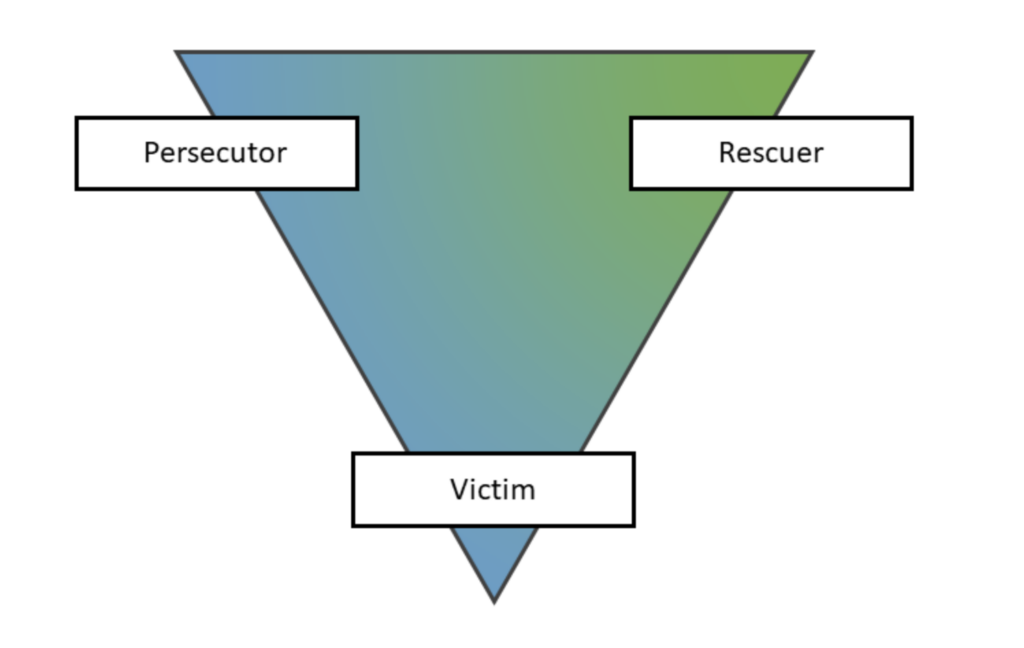
Here’s the tricky part. People don’t stay in one role. Instead, they rotate through all three positions. You might start as the Rescuer, trying to help your partner with their problems. Then you become the Victim when your efforts go unappreciated. Finally, you shift into Persecutor mode, criticizing your partner for being ungrateful.
A 2022 study in the Journal of Interpersonal Violence looked at people who often take on the Victim role. They report higher levels of anxiety, depression, and insecure attachment. The pattern itself creates emotional distress. It doesn’t matter which role you’re playing.
What Is Narcissistic Triangulation in Relationships?
Narcissistic triangulation is the deliberate version of this pattern. A person with narcissistic traits pulls a third party into the relationship on purpose, to create jealousy, competition, or self-doubt. Where ordinary triangulation in relationships is usually an unconscious way of managing anxiety, narcissistic triangulation is a control tactic.
It might look like a partner who constantly compares you to their ex. “She never complained about this.” Or a parent who plays favorites, praising one sibling to punish another. Or someone who claims invisible allies in every argument: “Everyone thinks you’re overreacting, not just me.”
The goal is to keep you off balance and competing for approval that never quite arrives. Over time, you may find yourself working harder to be chosen while trusting your own perception less and less.
If this dynamic sounds familiar, the manipulation may go beyond triangulation. Our post on narcissistic behavior covers the wider pattern, and our therapists specialize in helping women recover from these relationships.
Why Do People Get Stuck in These Patterns?
Most of us learned these patterns in our families of origin. If your parents handled conflict by venting to you instead of each other, that became your model for relationships. If you earned love by being the helpful one, rescuing became part of your identity.
Triangulation in relationships also serves a function. It relieves tension in the short term. Complaining to your best friend about your partner feels better than having a difficult conversation directly. Stepping in to mediate your parents’ argument gives you a sense of control. However, these short-term fixes prevent real resolution and keep everyone stuck.
How Can Therapy Help With Triangulation in Relationships?
Family systems therapy, based on Bowen’s work, helps you understand the triangles operating in your relationships. You learn to spot when someone is pulling you into their conflict. Then you can step back without cutting off the relationship.
Emotionally Focused Therapy (EFT) is particularly effective for couples caught in triangulation in relationships. EFT helps partners turn toward each other with their emotions instead of seeking relief from outside sources. You learn to have the hard conversations directly, which builds trust and intimacy over time.
For individuals healing from family-of-origin triangulation, therapy offers space to process how these patterns affected you. You can grieve the childhood you deserved while building new skills for your current relationships.
When Should You Seek Support?
Reach out if you often feel caught between people you love. Or if family conflicts keep pulling you back into old roles. Maybe you notice yourself repeating the same patterns despite your best efforts. Triangulation in relationships can feel impossible to escape alone. But therapy offers a path forward.
At Therapy for Women in Philadelphia, our therapists specialize in family systems approaches and EFT. We offer couples therapy, individual and family therapy to help you understand how family patterns shape your adult relationships.
Contact Therapy for Women to get started. We have office locations in Philadelphia, Bala Cynwyd and in Collingswood, NJ. It’s time to untangle the triangles keeping you stuck.





Leave a Reply